A common question I get asked by my patients is “what are acupuncture channels?” This has prompted me to write this blog to specifically answer that and trying to keep it jargon free and not overly technical.
Acupuncture is based on the principle that there is an energy flow through the body, which is referred to as Qi in Chinese medicine, Ki in Japanese and Prana in Ayurvedic Medicine. The vital force that circulates through the body.
This qi flows along specific channels called meridians, and these meridians form a network rather like a spiders web. Just like a web if you touch just one part it affects the whole. This organisation of channels forms the main picture of how the body is viewed as an energetic being not just a physical being. An excellent book on the topic for a fuller exploration – The Web That Has No Weaver by Ted J. Kaptchuk.
History of Acupuncture
Lets go way back to circa 980AD, when a physician called Wang Weiyi created a life-sized bronze statue, which was hollow, engraved with acupuncture meridians and depicting 354-657 acupuncture points throughout its surface. It had two main purposes, firstly as a teaching tool to standardise the teaching of acupuncture meridians and points and secondly as an examination tool. The latter was interesting, as the hollow bronze man was covered with a thin layer of wax and filled with water. The student would then be asked to locate an acupuncture point, if successful water would pour out from the point. Many of these original statues are now no longer around, rare examples can be found in museums but they have been replaced by rubber models that provide a good learning tool.
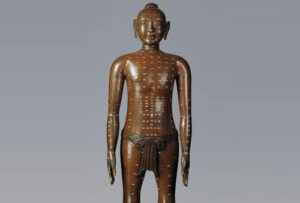
Ancient Bronze Man
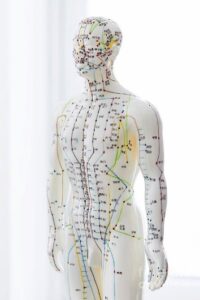
Modern Model
Acupuncture in Recent history
In the early 1950’s a Japanese doctor (Dr Y. Nakatani) developed a method based on electrical conductivity and subsequently discovered that there is a reduced electrical conductivity at an acupuncture point.
By the Mid 50’s independent studies in Germany, France and Russia confirmed these electrical anomalies.
Through the 70’s and 80’s the research continued and mapped the meridian system, which led to a suggestion that the meridian system operates along glial cells in a similar way to the principles of a semiconductor.
90’s to date there is a computerised system using digital imaging to collect data on the acupuncture points. The meridian system was standarised and internationally accepted and promoted by the World Health Organisation (WHO) in the early 80’s.
The Meridians
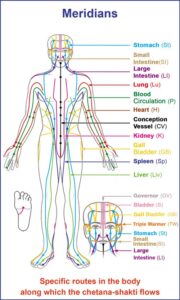
To give you a better understanding of these meridians please refer to Diagram 1 below. It looks overly populated because there are 12 main meridians but hopefully the different colours can help isolate the path of each one.
There are six meridians associated with the arm, three start at the hand and three finish at the hand. Similarly there are six for the leg, three start at the foot and three finish at the foot. Each of the twelve has a name which correlates to the organ of origin, as an aside here, all twelve can be felt on the pulse at the wrist (6 on either side). Taking the pulse gives the acupuncturist a good insight into the flow, quality, balance, and strength of energy/Qi of each organ and meridian.
The twelve organs/meridians are [in running order]
Gall Bladder (yellow),Liver (green), Lung (red), Colon (purple), Stomach (light blue), Spleen (navy), Heart (brown), Small Intestine (olive), Bladder (pink), Kidney (magenta), Pericardium (dark green), and Triple Burner (orange). Extra Channels Conception Vessel (Black) and Governor Vessel (Liliac).
This organisation for energy channels is not haphazard, there is a specific flow from one to the next, looping back to the first.
The meridians have along them acupuncture points, in classical teaching each has a name, but this was changed in modern China to a numeric system. So, the first point on the Gall Bladder meridian is GB1 Tong Zi Liao/Orifice of the pupil, it is approx. 1.3cm lateral to the eye, the channel runs down the body and ends up at the 4th toe GB44 Zu Qiao Yin/Foot cavity of Yin to then go on to the Liver meridian and so forth… traversing the body up and down finishing at the last Triple Warmer point TH23 Si Zhu Kong/Bamboo hollow at the lateral end of the eyebrow which is very close to GB1, the flow continues.
Flow of Energy/Qi
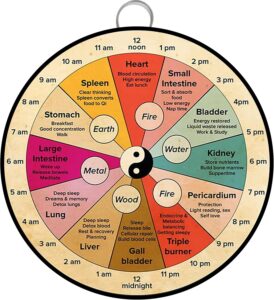
No that we have an idea of this network, lets overlay volume of flow. Diagram2, shows the order of flow according to time and charts the daily rhythm.
Example
Between 11pm and 1am – The peak tidal flow of energy is in the Gall Bladder organ and its corresponding meridian. Slightly increased in the meridians either side Triple Burner and Liver. Normal in Lung, Colon, Stomach, Bladder, Kidney, Pericardium. Lowest in the Heart, slightly low in Spleen and Small Intestine.
This tidal flow is continuous, and very important in how we should try to conduct ourselves on a daily basis.
Clinical application of Acupuncture
When I see a patient one of the factors that I try to determine is if there is a worsening of symptoms at particular times of day. If they tell me, it’s always worse at 6pm when they get in from work, my attention straight way goes to the energy in the Kidney meridian and organ. A surplus of energy usually exacerbates symptoms, but it might not relate to the Kidney in which case I might look at the Large Intestine which would have the least energy at that time of day. Follow up questions for the Kidney might include urination patterns or lower back pain, for the Large Intestine I might ask about bowel movements.
Channel theory is a very useful diagnostic tool, used with other information it can help clarify where problems arise, allowing the treatment to focus on the root cause of ill-health rather than an easing of symptoms.
Look out for the blog on Eight Extra Ordinary Meridians, which takes this topic to a deeper level.